

Synopsis
When agents began writing most of LupIQ’s code, the delivery metrics the company relied on stopped working. Fastloop got LupIQ’s team onto Claude, trained its engineers on Claude Code and the Claude API, and worked with LupIQ to design and build Neon and TheLoop. Neon now shows cycle time, rework, pull request trust, and token spend on every change LupIQ ships.
Highlights
Four blind spots in agent-driven delivery, now visible on every merged change
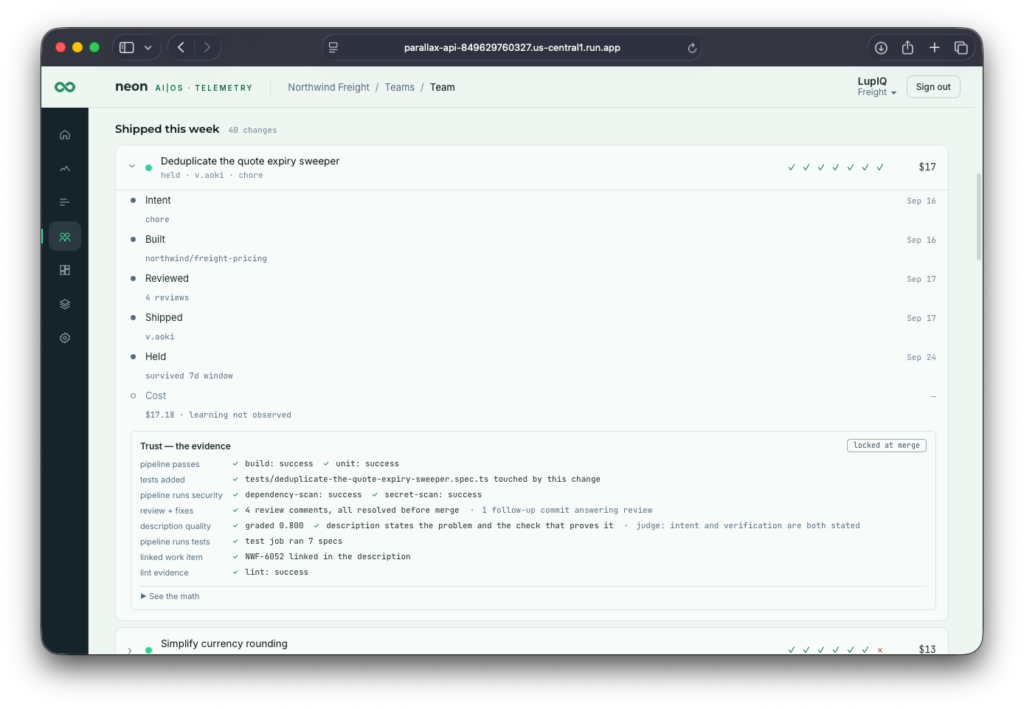
Every pull request gets a trust score built from eight kinds of evidence, locked at merge
Lead time for the slowest changes fell from over 30 days to 4.8 hours, made visible in Neon.
Challenges
LupIQ’s engineers write the spec, hand the work to an agent, and review what comes back. That approach lets LupIQ move fast, but it broke the numbers the company ran on. Velocity and story points assume a person wrote the pull request and a person read it. At LupIQ, neither is true.

Core challenges include:
Story points and velocity were designed for teams where people write and read the code. Once agents were writing most of LupIQ’s pull requests, those numbers no longer described how the work was actually getting done.
With agents opening pull requests all day, nobody could review each one closely. LupIQ needed a reliable way to know whether a given change carried the evidence a reviewer needs to trust it.
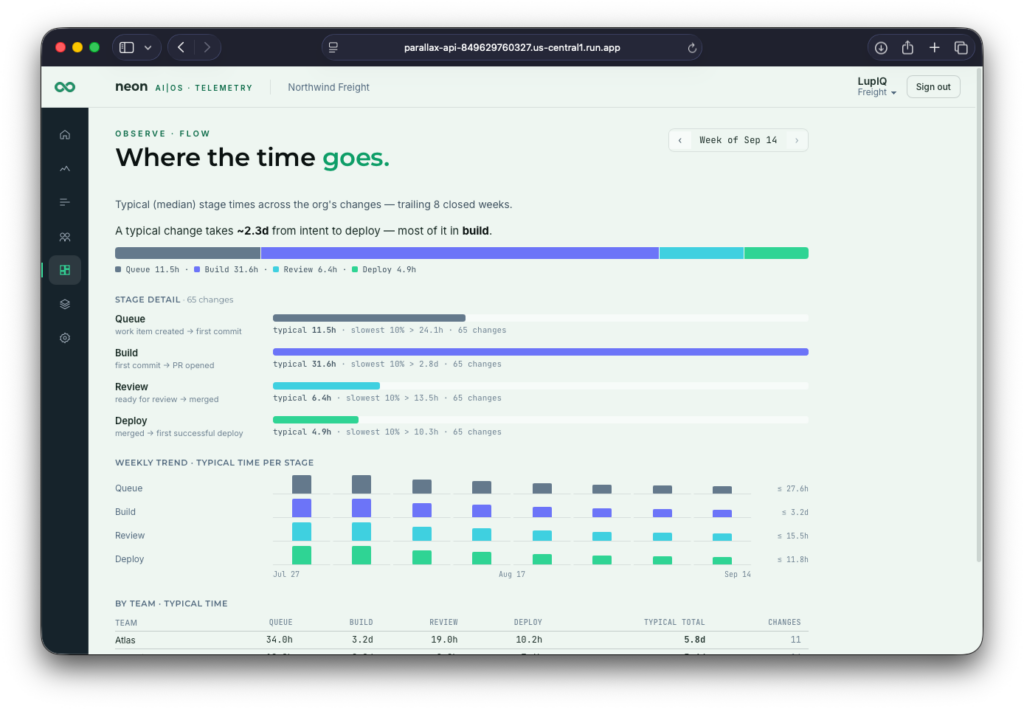
LupIQ could no longer see how long a change spent waiting, building, in review, and shipping. It couldn’t see how much work came back as rework or was reverted. It also couldn’t see what each change cost in tokens, tied to the work item that asked for it.
Solution
Fastloop started by getting LupIQ onto Claude. It advised on which Claude plan fit the team and trained the engineers on Claude Code and plugins. It then trained them on calling the Claude API from inside a product and on the Claude Agent SDK. Fastloop then worked with LupIQ’s engineers on the design and build of two products: Neon, an observability system for agent-driven development, and TheLoop, LupIQ’s own Claude Code plugin.
The decision Fastloop pushed hardest on was where the AI model belongs. A model can grade the quality of a pull request description, which no rule-based check can do. A model should never compute a number a user acts on. That principle runs through all of Neon. Claude grades and summarizes when data is written, and every number on screen is computed directly from source data.
Key components of the solution:
- Neon connects to GitHub and Jira and computes delivery metrics from those two sources alone.
- Where TheLoop is installed, telemetry from Claude Code sessions adds the metered token cost of each change, attributed to the work item that asked for it.
- Metrics follow SPACE-T, LupIQ’s extension of the SPACE framework that adds token accounting and trust.
- Every change gets a trust score built from eight kinds of evidence, from whether tests were added to whether the pipeline passed. Evidence Neon never saw is marked “not observed.” It adds nothing to the score, so Neon never guesses a pass or invents a fail.
- The trust score locks at merge. Later changes to the repo or pipeline can’t rewrite what was true when the change shipped.
- Neon runs on the Claude API through the Anthropic Python SDK. LupIQ’s team uses Claude Code with Sonnet and Opus for its daily work.
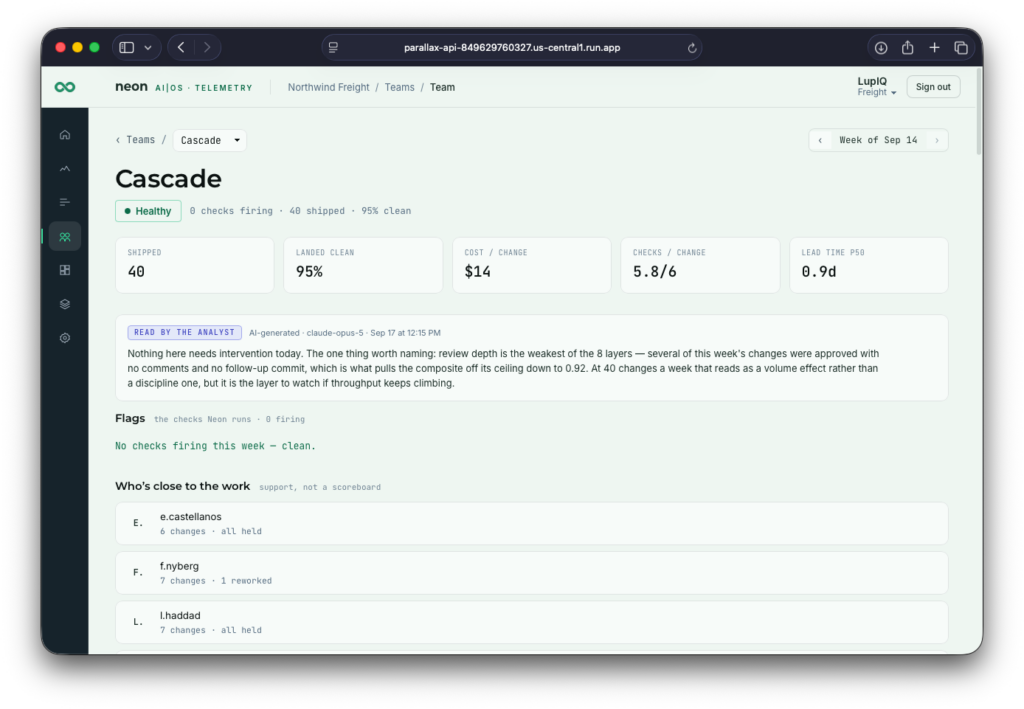
Daily stand-up view: Computed straight from source data with no AI model in the path. It includes five fixed checks: cost spike, revert, review latency, stuck in review, and thin assurance.
Weekly brief for team leads: Written by Claude and checked by code before it’s stored. Every number must trace back to an input Neon can cite, and a brief that fails the check is discarded entirely.
Scores changes, not people: Neon has no leaderboards and no per-person scores, and the weekly brief never names an individual contributor.
TheLoop, an open-source Claude Code plugin: TheLoop installs LupIQ’s delivery method in a repo as skills and agents and sends the telemetry Neon reads. It is free under the MIT license and, as of September 2026, ships 38 skills and 46 agents.

Results and Impact
Four blind spots, now observed on every merged change
LupIQ now sees cycle time at every stage (queue, build, review, and deploy), rework and reverts per team, a trust score for every pull request, and token spend per change attributed to its work item.
A clear view of how fast work actually ships
Measured in Neon, lead time for LupIQ’s slowest changes has gone from over 30 days to 4.8 hours. Neon didn’t cause that shift, but it made the shift visible.
In production every day
LupIQ was Neon’s first customer and runs it on its own delivery every day. Every merged change is scored and locked at merge.

Fastloop helped us not only build our stack but helped us see what was possible, their expertise in data systems and in building robust, enterprise-grade software was incredibly valuable.
– Russ Whitman, Co-founder, LupIQ
Why Fastloop.ai?
LupIQ needed more than tool setup.
It needed a partner who could get a team fluent in Claude and help design a product that engineers would trust.
Knowing where AI belongs, and where it doesn’t
Fastloop drew a firm line: Claude grades and summarizes, and code computes every number a user acts on. That principle shaped Neon’s architecture from the start.
Getting a team fluent in Claude
Fastloop took LupIQ’s engineers from choosing a plan through Claude Code, plugins, the Claude API, and the Claude Agent SDK. That gave the team the skills to build on Claude well beyond this project.
Data systems and enterprise-grade engineering
Fastloop’s background in data systems and robust enterprise software helped LupIQ build its stack and see what was possible.
Future Outlook
Neon doesn’t yet have a feed for deploys or incidents, so deploy frequency, change failure rate, and time to restore aren’t visible yet. The definitions already exist and compute correctly. The next layer is connecting the events that feed them.

Deploy and incident feeds
Connect deploy and incident events so Neon can see what happens after a change ships.

Building on the Claude Agent SDK
Apply the Agent SDK training Fastloop delivered to LupIQ’s next round of work.

Full delivery metrics
Light up deploy frequency, change failure rate, and time to restore alongside Neon’s existing measures.